
Web3 & Blockchain Development Agencies (2026): Rates & Vendor Guide
Struggling to find reliable Web3 & blockchain development agencies? Our 2026 guide covers rates ($150-$400/hr), L2s, audits, and red flags to help you hire.
Navigating the world of Web3 and blockchain development has transformed from a speculative gold rush into a strategic business decision. The echoes of the bull market hype have faded, replaced by a clear-eyed focus on utility, scalability, and sustainable value. For businesses in 2026, this presents a dual challenge: the opportunities are more real than ever, but selecting the right technical partner is fraught with peril. A top-tier Web3 development agency can build a secure, scalable, and user-friendly decentralized application (dApp); a poor one can lead to catastrophic financial loss, reputational damage, and technical debt. This guide provides an honest, post-hype look at the vendor landscape, offering specific data on rates, a deep dive into the technologies that matter, and a clear framework for vetting and selecting a Web3 & blockchain development agency that can deliver on its promises.
The 2026 Web3 Landscape: Beyond the Hype
The narrative has fundamentally shifted. The era of launching a project with a whitepaper and a prayer is definitively over. Today, the ecosystem demands robust technology, clear use cases, and a focus on user experience that rivals the best of Web2.
The End of Easy Money: A Mature Ecosystem
Projects are no longer funded based on speculation alone. Venture capital and corporate stakeholders demand sound tokenomics, audited code, and demonstrable product-market fit. This maturity has professionalized the space, forcing development agencies to move beyond simple token launches and NFT drops. The focus is now on complex DeFi protocols, Real-World Asset (RWA) tokenization platforms, and enterprise-grade blockchain solutions. This is an environment where technical excellence and a deep understanding of security are the primary currencies.
Layer 2s as the Default Development Environment
For years, Ethereum's high gas fees and low throughput were major barriers to adoption. Layer 2 (L2) scaling solutions have decisively solved this problem. For nearly all consumer and enterprise dApps, building directly on Ethereum's mainnet is no longer a viable or logical choice. L2s like Arbitrum, Optimism, Base, zkSync, and Polygon zkEVM offer near-instantaneous transactions and negligible fees, all while inheriting the security of the Ethereum mainnet. Agencies that don't have deep, demonstrable expertise across multiple L2 ecosystems are already behind the curve.
The Rise of Real-World Asset (RWA) Tokenization
Perhaps the most significant driver of Web3 adoption in 2026 is the tokenization of RWAs. This involves creating digital representations of tangible and intangible assets—like real estate, private equity, carbon credits, and intellectual property—on the blockchain. This market unlocks trillions of dollars in illiquid assets, creating new financial primitives. Development agencies are now being tasked with building the complex infrastructure for RWA issuance, management, and trading, requiring expertise in both complex financial regulations and advanced smart contract architecture.
Core Web3 Agency Service Offerings

A capable Web3 agency offers more than just coding. They are strategic partners who guide clients through the technical and philosophical complexities of decentralization.
dApp Development & User Experience
This remains the core service, but the standard has been raised. Users expect seamless, intuitive interfaces that abstract away the complexities of the blockchain. This involves integrating account abstraction (ERC-4337) for wallet-less experiences, designing transaction flows that are easy to understand, and building performant front-ends that interact flawlessly with smart contracts on the back end.
Smart Contract Creation & Auditing
This is the high-stakes table of Web3 development. Smart contracts are immutable and handle valuable assets, meaning a single bug can lead to irreversible losses. Agencies must have rigorous internal processes for writing secure, gas-efficient, and upgradeable contracts. Crucially, this service must be paired with a non-negotiable commitment to third-party audits. An agency's willingness to have its code scrutinized by elite external firms is a primary indicator of its quality and integrity.
DeFi Protocol & Platform Engineering
Building for Decentralized Finance (DeFi) is a specialized skill. It requires a deep understanding of financial concepts like automated market makers (AMMs), liquidity pools, lending and borrowing mechanics, and yield farming strategies. Agencies in this niche build everything from custom DEXs to complex derivatives platforms, requiring a level of mathematical and economic modeling that goes far beyond typical dApp development.
Understanding Agency Rates and Engagement Models
Budgeting for a Web3 project requires understanding the nuances of agency pricing, which reflects the high demand and specialized skill set of blockchain engineers.
Hourly Rates: What to Expect ($150-$400/hr)
For a reputable agency in North America or Western Europe, expect to pay between $150 and $400 USD per hour per developer.
- $150-$225/hr: Solid mid-tier agencies, often with a mix of onshore and offshore talent. Good for less complex dApps and initial prototypes.
- $225-$300/hr: Premium agencies with a proven track record, deep L2 expertise, and strong internal security practices.
- $300-$400+/hr: Elite-tier firms that specialize in highly complex DeFi protocols, RWA platforms, or foundational infrastructure. These teams often have renowned developers with extensive open-source contributions.
Project-Based vs. Retainer Models
- Project-Based: A fixed price for a defined scope of work. This is ideal for projects with a very clear, static set of requirements, such as a straightforward NFT minting contract or a simple informational dApp.
- Retainer: An ongoing monthly fee for a dedicated team or a set number of hours. This model is far more common for serious Web3 development, as it allows for the agility needed to respond to changing market conditions, user feedback, and the evolving technical landscape (e.g., new EIPs or L2 features).
The Hidden Costs: Audits, Gas Fees, and Maintenance
The agency's fee is not the total cost. You must budget for:
- Smart Contract Audits: This is a separate, critical expense.
- Deployment Gas Fees: While much lower on L2s, deploying and updating complex smart contract systems can still incur costs.
- Ongoing Maintenance: Blockchains evolve. Node maintenance, contract upgrades, and front-end monitoring are recurring costs.
The Crucial Role of Smart Contract Audits
In Web3, a third-party audit is not an optional extra; it is a fundamental requirement for any project that handles user funds or valuable assets. It is an independent verification of your code's security and integrity.
Why Audits Are Non-Negotiable
Smart contracts are, by design, immutable. Once deployed, the code cannot be easily changed. A single vulnerability, like a reentrancy bug or an integer overflow, can be exploited by malicious actors to drain a contract of all its funds. No serious investor will touch a project without a reputable audit, and launching without one is a signal of recklessness.
Top-Tier Audit Firms and Their Costs
Partnering with a top audit firm lends a project immense credibility. These firms have a deep roster of security researchers who rigorously test code for vulnerabilities. The cost of an audit varies based on the complexity and length of the codebase but typically falls within a range of $30,000 to $500,000+.
- Elite Firms: Trail of Bits, OpenZeppelin, ConsenSys Diligence. Engaging them is difficult and expensive, often reserved for foundational protocols and high-value DeFi projects.
- Highly Respected Firms: CertiK, Halborn, Quantstamp. These firms offer a balance of extreme rigor and broader availability, making them popular choices for a wide range of dApps and platforms.
Verifying Audit Reports: A How-To
Do not simply trust an agency that says, "We've been audited." Demand the report. A legitimate report is a PDF hosted on the auditor's own website or a public GitHub repository. Verify that the contract addresses in the report match the addresses of the deployed contracts you are interacting with. Be wary of reports that are simple images or text files that cannot be verified.
Key Technologies Shaping Development in 2026
Web3 development is a constantly moving target. Competent agencies are not just using today's tools; they are building for tomorrow's standards.
Account Abstraction: ERC-4337 and EIP-7702
Account Abstraction (AA) is the single most important evolution for Web3 user experience. It untethers users from the technical burden of managing seed phrases and gas fees.
- ERC-4337: This standard allows for "smart accounts" with features like social recovery, gas sponsorship (where the dApp pays gas for the user), and batched transactions. Any consumer-facing dApp must be built with ERC-4337 in mind.
- EIP-7702 (Expected in 2025): This anticipated Ethereum Improvement Proposal will make AA even more powerful and native to the protocol, simplifying its implementation and reducing costs. Agencies should already be planning their architecture around this future standard.
Cross-Chain Communication: Chainlink CCIP and Beyond
The future is multi-chain, and interoperability is key. Applications can no longer exist in a silo on a single L2. Chainlink's Cross-Chain Interoperability Protocol (CCIP) has emerged as an industry standard for securely sending messages and transferring value between different blockchains. A modern Web3 agency must be proficient in implementing CCIP or other robust interoperability solutions to build applications that can access liquidity and users across the entire Web3 ecosystem.
The Evolution of NFTs: From PFPs to Utility
The "NFT drift" describes the move away from static JPEG profile pictures (PFPs) toward NFTs with real-world utility. This includes using NFTs as access passes, for digital identity, to represent ownership of RWAs, or as dynamic game assets. This requires more complex smart contract logic and a deeper integration with the dApp's functionality.
Comparison of Top Blockchain Platforms for Development
| Feature | Ethereum (L1) | Arbitrum (L2) | Base (L2) | zkSync (L2) |
|---|---|---|---|---|
| Security Model | Own Validators | Inherits from Ethereum | Inherits from Ethereum | Inherits from Ethereum |
| Transaction Cost | High ($5 - $50+) | Very Low (<$0.10) | Very Low (<$0.10) | Very Low (<$0.05) |
| Transaction Speed | Slow (~12 minutes for finality) | Fast (~1 second) | Fast (~1 second) | Fast (~1 second) |
| Primary Use Case | Global Settlement, Security Layer | DeFi, Gaming, General dApps | Consumer dApps, Social, Onchain Brands | DeFi, Payments, Privacy-sensitive Apps |
| Developer Ecosystem | Massive, most established | Massive, EVM-compatible | Growing rapidly, Coinbase ecosystem | Strong, ZK-focused, EVM-compatible |
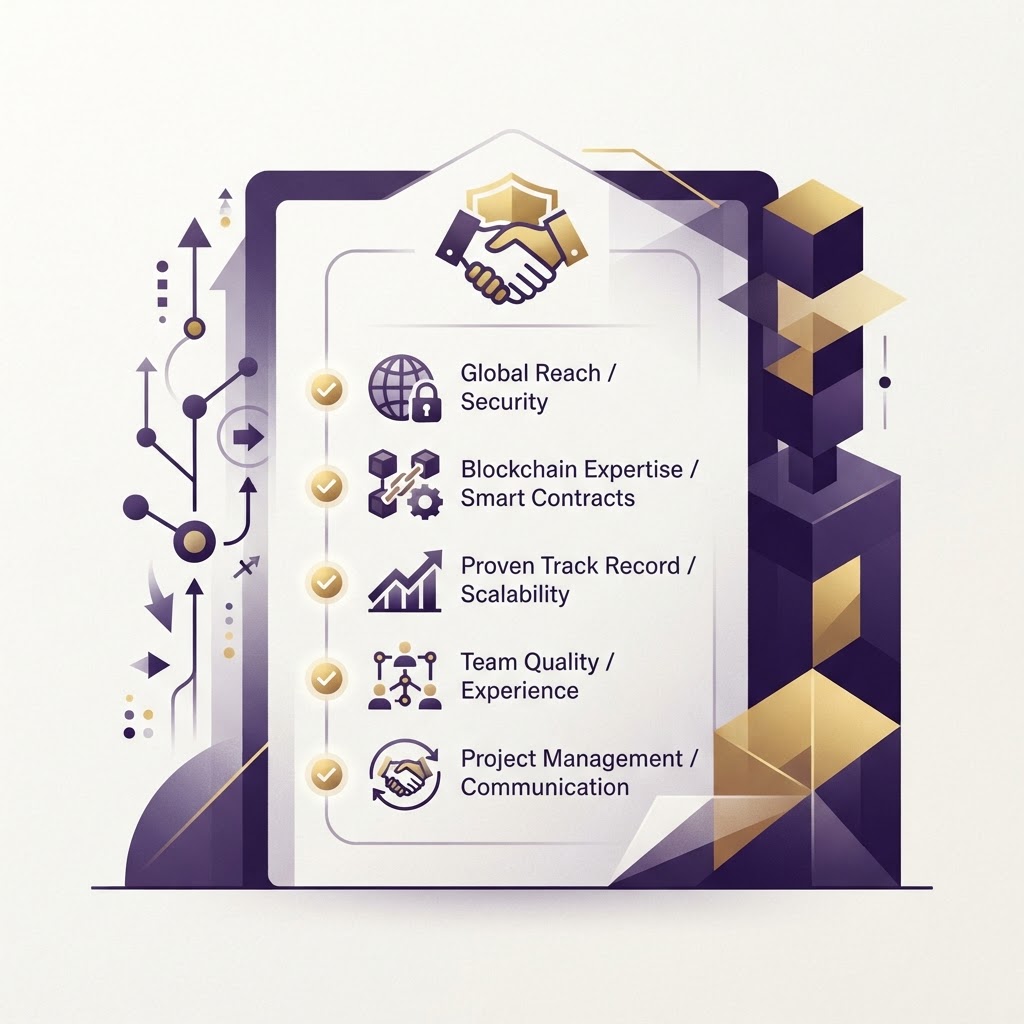
Vendor Selection Checklist
- Verify On-Chain Portfolio: Don't just look at a web portfolio. Ask for deployed contract addresses on Etherscan, Arbiscan, etc. Do the projects have real transaction volume and users?
- Interview a Lead Developer: Do not get stuck talking only to the sales team. Insist on a technical call with the actual developer or architect who would lead your project.
- Confirm L2 & Tooling Expertise: Ask them to detail their experience with specific L2s (Base, Arbitrum) and tools (Foundry, Hardhat). Ask how they would approach building for account abstraction.
- Discuss Security & Auditing Philosophy: Ask them who their preferred audit partners are. Do they use static analysis tools like Slither? What is their internal code review process?
- Request Client References (and check them): Talk to 2-3 previous clients about their experience. Ask about communication, budget adherence, and technical execution.
- Verify Audit Reports: For their past projects, find the audit reports and verify they are legitimate and hosted by the auditor.
- Evaluate Communication and Project Management: How will they communicate progress? What project management tools (Jira, Linear, Notion) do they use? Is there a dedicated project manager?
- Look for Open Source Contributions: Have their developers contributed to Web3 protocols, EIPs, or open-source libraries? This is a strong signal of deep expertise.
- Assess Understanding of Your Business Case: Can they articulate how their technical proposal solves your specific business problem, or are they just selling a technology?
- Get a Detailed Scope of Work (SOW): Ensure the SOW is incredibly specific, with clear milestones, deliverables, and a breakdown of costs. Vague SOWs lead to scope creep and disputes.
- Avoid Guarantees of "Success" or "Returns": A professional agency sells technical execution, not investment outcomes. Promises of token price appreciation are a massive red flag.
- Clarify Post-Launch Support: What does the maintenance and support agreement look like after the initial launch?
FAQ
How much does it cost to build a simple dApp?
A simple dApp, like a basic NFT minting site or a simple ERC-20 token dashboard, can cost between $50,000 and $150,000. This assumes a clear scope, minimal on-chain complexity, and development on a low-cost L2. This price includes smart contract development, basic front-end work, and a security audit from a mid-tier firm. Complex DeFi platforms or RWA tokenization systems will be significantly more, often starting at $500,000 and running into the millions.
What's the difference between a Web3 agency and a smart contract auditor?
They are two distinct and essential parts of the ecosystem that must remain separate to avoid conflicts of interest. The Web3 agency is the builder; they write the code, design the architecture, and create the user interface. The smart contract auditor is the inspector; they are an independent third party that rigorously tests the code written by the agency to find vulnerabilities. An agency should never audit its own code, as this completely defeats the purpose of an independent security review.
Do I really need to build on a Layer 2?
Yes, for almost every conceivable use case. Building directly on Ethereum L1 is prohibitively expensive for users and slow for applications. The only exceptions are projects that require the absolute highest level of security and decentralization for infrequent, high-value transactions, like settling bonds between nations or managing a foundational protocol's treasury. For any application that requires user interaction, an L2 like Arbitrum, Base, or zkSync is the only logical choice in 2026.
What is Real-World Asset (RWA) tokenization and why does it matter?
RWA tokenization is the process of creating a digital token on a blockchain that represents ownership of a real-world asset. This could be a share of a rental property, a piece of a fine art painting, or a stake in a private credit fund. It matters because it has the potential to make previously illiquid markets accessible, transparent, and efficient. By tokenizing an asset, you can divide it into smaller pieces, trade it 24/7 on global markets, and use it as collateral in DeFi protocols, unlocking immense economic value.
How will EIP-7702 change the user experience?
EIP-7702, once implemented, will supercharge Account Abstraction. Today with ERC-4337, users have smart accounts, but they often need a separate transaction to authorize actions. EIP-7702 will allow users to temporarily convert their standard Externally Owned Account (EOA) wallet (like MetaMask) into a smart account for the duration of a single transaction. This means users can get the benefits of AA—like having a dApp pay for their gas fees—without migrating to a whole new wallet structure. It dramatically simplifies the path to a Web2-like experience where users can sign in and interact without needing to hold the chain's native token (e.g., ETH) for gas.
Next Steps
The Web3 space has matured into a formidable and complex technological frontier. Choosing the right development partner is the most critical decision you will make on this journey. The era of hype is over, and the era of diligent execution is here. Use this guide and the provided checklist not as a mere suggestion, but as a mandatory process. Vet your potential partners rigorously, prioritize security above all else, and focus on building real, sustainable value. The future of the decentralized internet is being built today; ensure you are building it on a solid foundation.
Ready to hire a top-ranked firm?
Browse thousands of vetted agencies on TopRankFirms.